
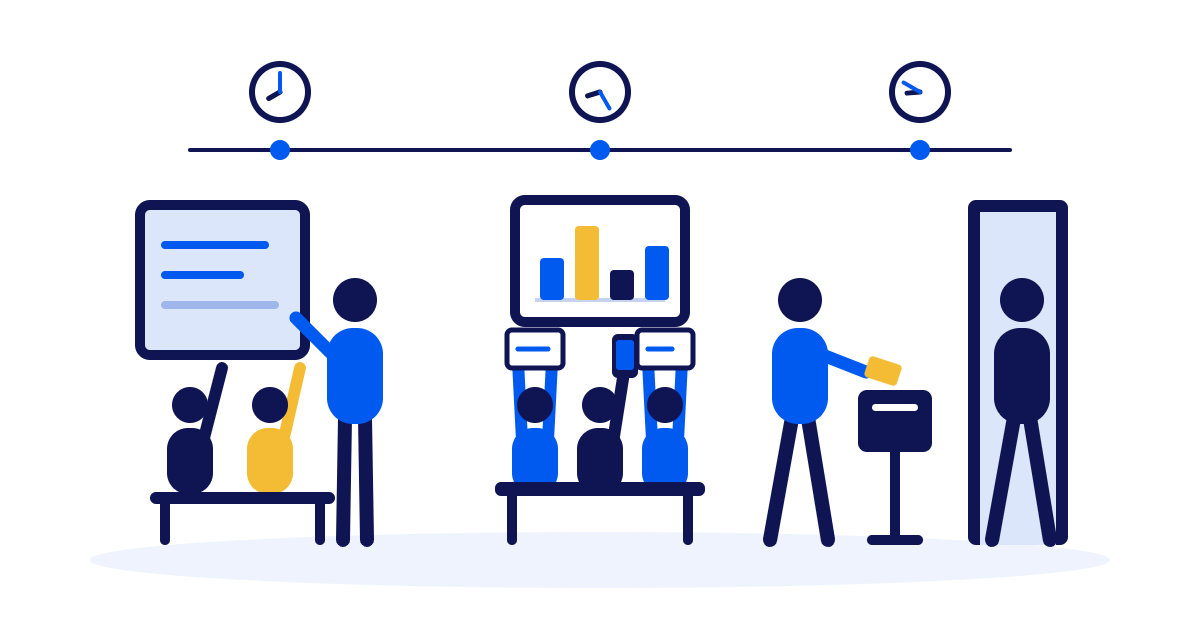
Every list of formative assessment examples has the same problem: fifty ideas in alphabetical order, and no way to know which one fits the minute you're in. A think-pair-share at 8:05 and an exit ticket at 8:50 do different jobs — and the job is what makes a technique formative or decorative.
So this list is organized by the moment of the lesson: seven techniques for the start, seven for the middle, seven for the end. Each comes with a copy-and-use prompt, one line on what it reveals, and one on what to do with the answers — because a check you don't act on is just an activity.
What makes an assessment formative?
A check is formative when it is quick (minutes, not a lesson), low-stakes (not graded, or not counted), specific (about the current objective) and — the part most lists skip — acted on (the answers change what happens next: tomorrow's opening, today's next example, who gets help).
Same activity, different use: a five-question quiz is formative if it plans tomorrow and summative if it goes in the gradebook. The family has three members: the diagnostic check before a unit, the formative checks inside it, the summative test at the end.
At the start of a lesson: 7 examples to surface prior knowledge
1. Bell ringer (do-now) — "Solve this one problem from yesterday while I take attendance." Reveals whether yesterday stuck; then: start with the error you see most.
2. Five-question diagnostic — "Five quick questions on what you need for today — not graded." Reveals prerequisites; then: group by need, or reteach one gap before starting. (More on the diagnostic check.)
3. KWL chart — "What do you Know about [topic]? What do you Want to know?" Reveals prior knowledge and misconceptions; then: address the misconceptions you read, and return to the L column at the end.
4. Four corners — "Go to the corner that matches your view: strongly agree, agree, disagree, strongly disagree." Reveals the class's baseline stance; then: pair opposite corners for the discussion.
5. Concept sketch — "Draw what happens when [process] in 90 seconds — no words." Reveals mental models; then: project two contrasting sketches and ask which is right and why.
6. Confidence vote — "Thumbs up if you could teach this, sideways if you get it, down if you're lost." Reveals perceived readiness (not competence); then: pair it with one real question to compare.
7. Vocabulary match — "Match these six terms to their definitions — in pairs, two minutes." Reveals whether the lesson's language is in place; then: teach the two terms most pairs missed.
During the lesson: 7 examples to catch misunderstanding in real time
8. Live quiz question — "One question on the screen, answer from your phone — 30 seconds." Reveals the whole class's understanding at once, per option; then: if the same wrong answer wins, reteach that misconception now.
9. Think-pair-share — "Think for one minute. Explain to your partner for two. Then we share." Reveals reasoning, not just answers; then: listen to the pairs and collect the wrong explanations to address.
10. Mini whiteboards — "Write your answer and hold it up on three." Reveals thirty answers in one glance; then: pick a wrong one (anonymously) and ask the class to fix it.
11. Fist to five — "Show me zero to five: how well could you do this alone?" Reveals confidence distribution; then: fives explain to twos.
12. Spot the error — "Here is a worked solution with one mistake. Find it." Reveals whether students can evaluate, not just execute; then: ask what rule the mistake broke.
13. Hinge question — "One question with four options — each wrong option is a specific mistake." Reveals which misconception each student holds; then: the answer distribution decides whether the lesson moves on or loops back.
14. Traffic-light cups — "Green: I'm fine. Yellow: I have a question. Red: I'm stuck." Reveals who needs help without interrupting; then: circulate by color.
At the end of a lesson: 7 examples to plan tomorrow
15. Exit ticket — "Before you leave: one question on today's key idea." Reveals whether the core objective landed; then: sort into three piles — that's tomorrow's opening.
16. One-minute paper — "In one minute: the most important thing you learned, and the most confusing." Reveals both understanding and gaps; then: open tomorrow with the most common confusion.
17. 3-2-1 — "Three things you learned, two you found interesting, one question you still have." Reveals depth and curiosity; then: answer the best "one question" first thing.
18. Muddiest point — "What was the muddiest point of today?" Reveals the exact spot to reteach; then: do it in the first five minutes tomorrow.
19. Two roses and a thorn — "Two things that went well, one that was hard." Reveals strengths to build on and one blocker; then: address the most frequent thorn.
20. Summarize in a sentence — "Today's lesson in one sentence, under twenty words." Reveals whether students can compress the idea; then: read three aloud and ask the class to pick the best.
21. Prediction — "Tomorrow we'll look at [next topic]. What do you think happens when…?" Reveals what students bring to the next lesson; then: open tomorrow with the predictions.
The five strategies behind every good example
Behind the twenty-one techniques sit five strategies. Share the objective: students can't check their understanding of a target they don't know. Elicit evidence: every technique above is a way of making thinking visible. Give feedback that moves learning forward: what to do next, not a score. Activate students as resources for each other: pairs, explanations, error hunts. Activate students as owners of their learning: self-assessment, confidence votes, questions they still have.
Every example on this page serves at least two of the five.
Paper, hands or a PIN? Choosing the format
Hands and whiteboards cost nothing and work in any classroom — their limit is memory: nothing is kept, and thirty whiteboards are read in a glance and forgotten. Paper (exit slips, one-minute papers) keeps a record at the cost of an evening of sorting.
Digital removes the sorting: students answer the same question from their phones with a PIN and no account, and the teacher sees the distribution per question and per student the moment the timer ends — with the record kept for tomorrow. With PanQuiz the live quiz question, the hinge question, the diagnostic and the exit ticket are all the same object: a short quiz, written by hand or generated by AI from the lesson's material — with the AI Quiz Generator or PDF to Quiz — played live with per-question results. For the software landscape beyond PanQuiz, see the tools guide. Licenses are per teacher with education discounts; the 15-day Premium trial needs no credit card.
Turn any example on this page into a one-minute live check: write the question, share the PIN, see every answer per student before the next slide.
Start your free 15-day trial→Three ways formative assessment stops being formative
Grading it. The moment it counts, students hide what they don't know.
Collecting without acting. If tomorrow's lesson is identical to the plan, the check was decoration.
Doing it once a week. Formative assessment is a rhythm — one check per lesson, short, beats one long check on Fridays.